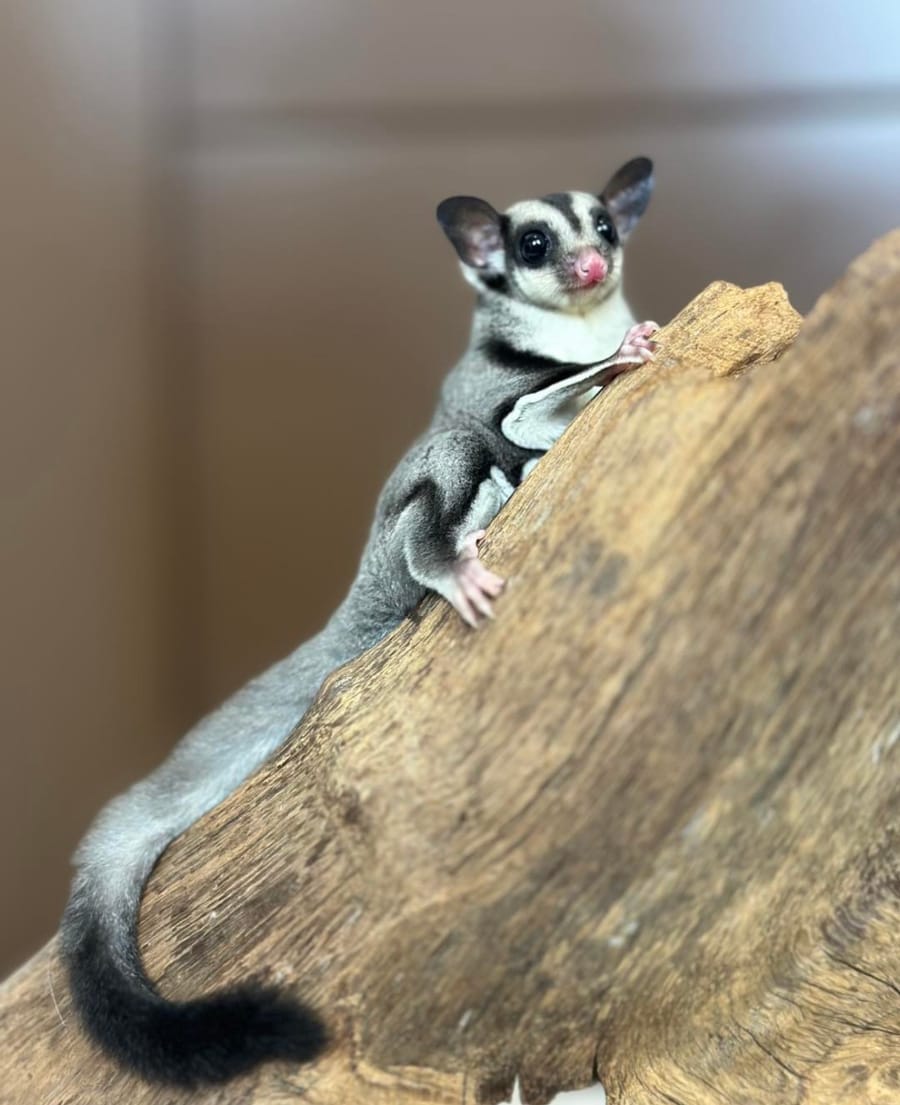
What Is a Sugar Glider? A Filipino Owner’s Guide
Hold a sugar glider for the first time and the first thing you notice is the weight, or rather the lack of it. A full-grown adult sits at around 100 to 160 grams, light enough to ride in a shirt pocket all evening without you remembering it is there until it chirps. The second thing you notice is that it is watching you back. This is not a hamster going through the motions. It is a small, social, intelligent animal deciding whether you are safe.
If you are weighing up a sugar glider in the Philippines, start here. Knowing what the animal actually is will tell you more about whether it suits your life than any photo ever could.
A marsupial, not a rodent
Sugar gliders are often mistaken for rodents or flying squirrels, and they are neither. They are marsupials, in the same broad family as kangaroos and possums, which means females carry their young in a pouch. The resemblance to a flying squirrel is pure coincidence of evolution: two unrelated animals that both solved the problem of moving between trees by growing a gliding membrane. A squirrel is a rodent. A sugar glider is closer to a tiny possum.
Their native range runs across Australia, New Guinea, and parts of Indonesia, where they live in tree canopies in family colonies. That single fact, that they evolved as colony animals, explains most of their behaviour as pets. They are wired to be with their own kind.
In Tagalog, you will hear them called simply “sugar glider”, since there is no traditional Filipino name. They are not native to the Philippines, and the ones kept here are captive-bred, not taken from the wild.
How the gliding actually works
The membrane is called a patagium, and it stretches from the wrist to the ankle on each side. When a glider leaps and spreads its limbs, that loose skin pulls taut into a square parachute, and the animal sails in a controlled descent, steering with its legs and using its tail as a rudder. In the wild they cover impressive distances tree to tree. In your living room, expect a glider to launch off a curtain rail and land cleanly on your shoulder from across the room, which is equal parts charming and a reason to close the windows.
This is also why cage height matters more than floor space, a point we cover in the cage setup guide. A glider wants to climb up and glide down. A wide, short cage wastes the one thing the animal is built for.
How long they live
Kept properly, sugar gliders live ten to fifteen years. That is the number most new owners underestimate, and it is the most important one on this page. You are not buying a pet for a season. You are taking on an animal that may still be with you in 2040, that will need the same diet and attention in year twelve as in year one, and that bonds to you specifically.
We are deliberate about who we place joeys with for exactly this reason. A decade is a long time to commit to anything.
What living with one is actually like
A sugar glider runs on a schedule that is the opposite of yours. They are nocturnal, waking around dusk and most active late into the evening. An owner who is out all day and asleep by ten will struggle to give a glider the interaction it needs, because the animal is only just warming up as you wind down. Evening people do best.
They are loud in small bursts. The defensive sound, called crabbing, is a rapid chattering they make when startled, and new owners often mistake it for aggression when it is closer to a flinch. They also bark, a surprisingly dog-like sound, usually for attention. None of it is constant, but a glider is not a silent pet.
And they bond. A well-socialised glider will seek you out, ride in a pouch against your chest for hours, and treat your hand as home base rather than a threat. That bond is the whole reward of the species, and it is why a hand-raised joey is worth so much more than a cheaper, unhandled one. We go deeper on this in the bonding guide.
Are they right for the Philippine climate?
This is one place local experience matters. Sugar gliders are comfortable in the warm range most Philippine homes sit at naturally, which spares you the heating that keepers in colder countries fuss over. The catch is air-conditioning. A glider kept in a heavily air-conditioned room can get too cold, especially at night, so the enclosure belongs somewhere with steady, mild warmth and good airflow rather than directly under an aircon unit. Humidity is rarely a problem here; ventilation and shade from direct afternoon sun are what to watch.
Frequently asked questions
Is a sugar glider a rodent? No. It is a marsupial, related to possums and kangaroos. The likeness to a flying squirrel is coincidental.
Can sugar gliders really glide indoors? Yes. A confident glider will launch from a high point and glide several metres to land on you. Keep windows and doors closed during out-of-cage time.
How long do sugar gliders live? Ten to fifteen years with good care, which makes them a long-term commitment rather than a short-term pet.
Are sugar gliders legal to keep in the Philippines? Yes, when properly documented. We cover the legal side fully in Are Sugar Gliders Good Pets?, and every joey we place comes with full DENR paperwork.
Decided a glider is for you?
If reading this made you more interested rather than less, that is usually a good sign. See the joeys ready now.
Call to Reserve → +63 945 995 0591 Call or text to reserve. From ₱13,000, DENR papers included. In-person delivery available.